More on the Stickability of "No Religion" and Religion
Yesterday, I posted about data that has come out of the UK that shows that "nones" are increasing in proportion of the population and that "no religion" appears to stick more with people than religion, particularly Christianity. In other words, if you were born into "no religion" households, you are more likely to stay that way than if you were born into Christian households.
I asked for a little help with locating some sources for data and data representation, and some readers have been forthcoming (thank you). I will update this piece as more info comes through. Some data is a little old now (2009 and 2010). What I can say is that it is a different picture in the US than it is in the UK.
First of all, let's look at an infographic from the Internet Monk using 2009 data in the US:
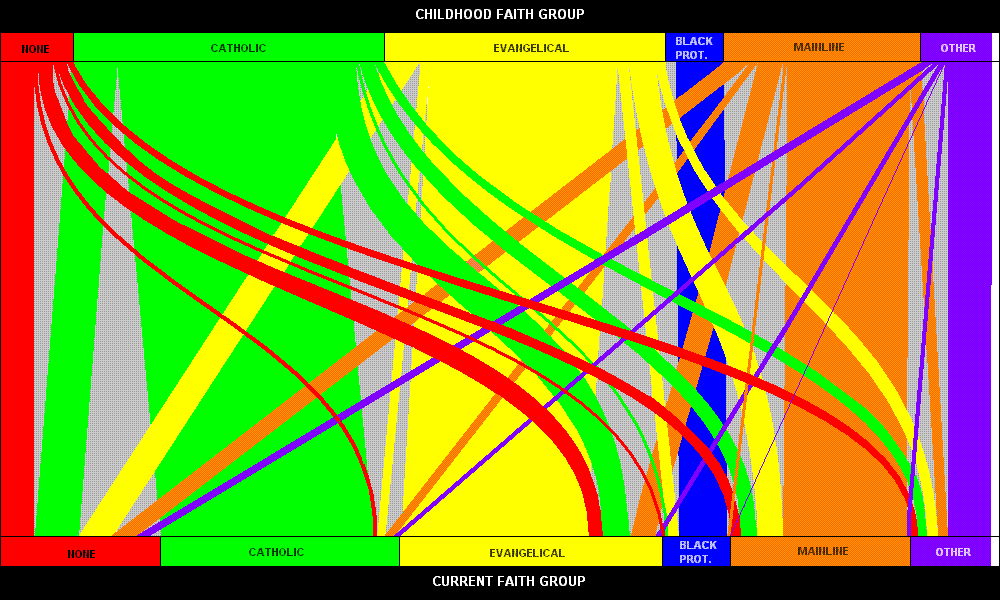
What this tells us is that black protestants appear to hold on quite well, though there are some missing. Catholics lose a good portion to "nones". Evangelicals and mainlines lose out a little in total. "Nones" seem to gain the most, but they also lose some, too (remember, this is 6 years old now - the trends have continued, with "nones" continuing to make large gains). There is a potential paradox here, as Michael Bell points out:
The “None” group, now makes up a total of 16.1% of American adults today, a huge increase from the 7.4% who were in this group in their childhood. The interesting paradox is that of those who were raised in this group half now have a religious affiliation, with 1.6% of American adults moving from None to Evangelical (yellow) and 1.0% moving to Mainline Protestant (orange) religious beliefs. Yet, while the None group has had significant outflows they have had much more significant inflows. 4.4% of American adults have switched into this group from Catholic (green). This is 11 times greater than the move from None to Catholic. 3.5% have moved to None from the Evangelicals, more than double the outflow, and 2.7% from Mainline Protestants, almost triple the outflow. There has also been an inflow of .8% of American adults to None from people who classified themselves simply as Protestant, without being willing or able to be more specific. This is represented by a blank space on the chart as we don’t know specifically from where these moves came.
Catholics are the big losers as they give to many others but receive less. This is also borne out by the Pew data from 2015 (spanning time from 2007). As USA Today states:
Catholics dropped both in market share and in real numbers. Despite their high retention rate for people reared in the faith, they have a low conversion rate. Today, Cooperman said, 13% of U.S. adults are former Catholics, up from 10% in 2007.
Generational shifts are also hurting Catholic numbers. Greg Smith, Pew's associate director of research, said "just 16% of the 18-to-24-year-olds today are Catholic, and that is not enough to offset the numbers lost to the aging and switching."
Where are they going? To religious nowhere.
These "nones" are gaining some serious momentum:
"Nones," at 22.8% of the U.S. (up from 16% just eight years ago) run second only to evangelicals (25.4%) and ahead of Catholics (20.8%) in religious market share.
The "nones" numbers are now big enough to show noteworthy diversity:
Atheists rose from 1.6% to 3.1%, and agnostics from 2.4% to 4%. Combined, there are more "nones" than Evangelical Lutherans, United Methodists and Episcopalians all together.
The trends and demographics concerning "nones" are at once interesting and not surprising:
"None" is the winning category for religious switchers across society, particularly among gay and lesbians — 41% of gay or lesbian Americans say they have no religion. Cooperman said. "This suggests the degree of alienation and discomfort and sense of being unwelcome that they may have felt in traditional religious groups."
Other trends of note:
Intermarriage is rising with each generation. Among Americans who have gotten married since 2010, nearly four-in-ten (39%) report that they are in religiously mixed marriages, compared with 19% among those who got married before 1960, according to the report.
There's an identity gender gap. Most Christians are women (55%) and most "nones" are men (57%). However, women's unbelief numbers are growing: nearly one in five (19%) now say they have no religious identity.Diversity makes a difference. Racial and ethnic minorities now make up 41% of Catholics (up from 35% in 2007), 24% of evangelicals (up from 19%) and 14% of mainline Protestants (up from 9%). "The share of Americans who identify with non-Christian faiths also has inched up, rising 1.2 percentage points, from 4.7% in 2007 to 5.9% in 2014. Growth has been especially great among Muslims and Hindus," the report said.
The progressive shift in cultural morality has something to answer for here.
So for the US, the figures are a little more muddled than for the UK: "nones" are receiving a nett gain, large in percentage increase for their numbers; but they also seep numbers to other groups. They lose almost half of their numbers, as the Pew Research Center reports:
By a wide margin, religious “nones” have experienced larger gains through religious switching than any other group. Nearly one-in-five U.S. adults (18%) were raised in a religious faith and now identify with no religion. Some switching also has occurred in the other direction: 9% of American adults say they were raised with no religious affiliation, and almost half of them (4.3% of all U.S. adults) now identify with some religion. But for every person who has joined a religion after having been raised unaffiliated, there are more than four people who have become religious “nones” after having been raised in some religion. This 1:4 ratio is an important factor in the growth of the unaffiliated population.
That 1:4 ratio is the important one, because the losses are more than made up for.
The UK, on the other hand, sees a much greater stickability of "nones". Those born into households of "no religion" are much more likely to retain that moniker. Here is an infographic from 2009 (now somewhat outdated, for sure - if anyone can find anything more recent, please let me know):

[Thanks to Andrew G. for sourcing these two images]
As you can see from this image, "nones" lose miniscule amounts to some of the Christian and non-Christian faiths, and essentially retain their proportion, gaining significantly from the others, in terms of time from upbringing to adulthood. Here, we can see a far greater degree of stickability of "no religion" in the UK compaed to the US, where it leaks almost half, but is replaced four fold.
Though this says little about stickability, the BHA reports on surveys concerning religiosity:
In the UK, the percentage of the population which describes itself as belonging to no religion has risen from 31.4% to 50.6% between 1983 and 2013 according to the British Social Attitudes Survey’s 31st report issued in 2014. Conversely, the report found that only 41.7% of people in the UK identify as Christians compared to 49.9% in 2008 and 65.2% in 1983. The Church of England has seen the greatest decline in its numbers; membership has more than halved from 40.3% of the population in 1983 to just 16.3% in 2014.
Among people aged between 18 and 24, the incidence of religious affiliation is only 30.7%. It is only amongst the over 55s that the majority of respondents are religious. But even then, only 47% of English funerals in 2012 were performed by the Church of England, Roman Catholic Church, and Methodist Church, down from 59% in 2005.
A 2014 Survation poll found 60% of the British public describing themselves as not religious at all, compared with a third being somewhat religious and 8% very religious.
A 2014 YouGov poll found that 50% of the population do not ‘regard themselves as belonging to any particular religion’, compared to 43% who do. It also found that only 3% of the population consider themselves to be ‘very religious’ and only 20% ‘fairly religious’, while 37% consider themselves to be ‘not very religious’ and 40% ‘not religious at all’.
The BSA (British Attitudes Survey), as reported by British Religion in Numbers, gave some interesting things to ponder (based on 2012 data):
Asked whether they had ever discussed with anyone their wishes in six areas should they not have long to live, 51% said in 2012 they had discussed nothing, while 11% had discussed their spiritual and religious needs (12% in 2009). Women (15%) are more likely than men (9%) to have discussed their spiritual and religious needs, and similarly older than younger age groups, and higher than lower social grades.
Among those with a current religion and/or brought up in one, weekly attendance at religious services (excluding rites of passage) now runs at 12%, with a further 8% claiming to worship at least monthly and another 14% at least once a year. By contrast, 58% worship never or practically never.
Although just 20% had not had a religious upbringing, as many as 48% overall professed to belong to no religion at the time of interview in 2012, a proportion which increased steadily with each generation cohort (standing at 60% for those born in the 1980s against 25% for those born in the 1920s). Church of England was still the single biggest denominational/faith category in 2012 but, at 20%, it was 16% fewer than the number brought up as Anglicans, and much reduced from the 40% recorded when the question was first put in 1983.
and
Religion continues to be closely associated with attitudes to abortion. Catholics are the least accepting, with only 39% supporting a woman’s right to terminate a pregnancy if she wishes to, against 56% of Anglicans. Those professing no religion are most supportive of all (73%, compared with 62% of all Britons). However, acceptance of abortion has increased among all faith communities since 1983; in the case of Anglicans, for example, just 34% endorsed abortion in these circumstances thirty years ago.
Despite a similar process of liberalization of attitudes over time, people of faith are still appreciably more disapproving of homosexuality than society at large. Indeed, the gap between the religious and non-religious on this issue is now far wider than in the past. Overall, 28% of Britons in 2012 deemed sexual relations between two adults of the same sex to be always or mostly wrong, but the proportion fell to 16% among the irreligious and climbed to 61% of non-Christians (with 35% for Catholics and 40% for Anglicans).
All religious groups apart from non-Christians have become more accepting of premarital sex over the past three decades, the number of Anglicans and Catholics describing it as always or mostly wrong now being reduced to one in ten (much the same as in the population as a whole), compared with almost one in three in 1983. Most tolerant of all are people of no religion, only 2% of whom in 2012 considered premarital sex to be wrong (11% in 1983). Frequency of attending religious services also has an impact; whereas 71% of non-attenders said in 2012 that premarital sex is not at all wrong, this was true of only 23% of weekly attenders at worship.
Anyway, lots of information to ponder. For me, what is clear is that there is a very different cultrual milieu that separates the US from the UK, but that the end result appears to be the same. Both countries are gaining religious "nones" at a decent rate.
