My Catalogue of Books
I thought I would remind readers, or indeed let them know if they are unaware, of the books that I have available for their intellectual edification. I will list these in chronological order of release, with others I have edited below that. Please support my work by getting any of these titles, and better still, by buying them through the widgets to the right of your screen (although you may have them adblocked...). Here goes...

If you are interested in and introduction to the age-old debate over whether free will exists, then there is always my book Free Will? An investigation into whether we have free will or whether I was always going to write this book. Here is one of the latest reviews:
Jonathan Pearce has written what is quite possibly the most detailed explanation of the problems with free will. He covers philosophical, scientific, and theological issues that conflict with humans being the author of our choices. I would recommend this book to free will believers who are Christians because they will find familiar concepts that will teach them more about their own beliefs as well as that of others. Particularly interesting is the parts about Calvinism and Molinism. I learned some thing I didn't know before. But the final reason that free will is impossible has nothing to do with religion. Determinism cannot be escaped for the atheist either. This is a book for everyone. The fifth part of the book is about the concepts of morality, responsibility, and the purpose of punishment. For the determinist, punishment can only serve as a correction for criminals to ensure that they do not repeat the crimes. Any feeling of retribution is gone for those who see free will for the illusion that it is.

And then there is The Little Book of Unholy Questions, the cumulative case against the existence of God written as a series of question directly to God. These are grouped into sections which I introduce, giving more depth to the areas. Here's what Julian Haydon had to say:
Five stars squared for this little book, dynamite in a small package!
How devastatingly powerful are simple questions presented so clearly and respectfully. Pearce says in few words what others take books to do. Though not a scholar, I have spent years pondering some of these questions but very many caused me to wonder, "Why did I not think of that, it is so obvious?"
How many of the scores of millions of intelligent and well-meaning Christians would be simply astonished and incredulous to find that nearly all of these questions arise from both the Old and New Testaments and Christian doctrine?
In fact, for those millions of Christians who have only read parts of the bible -- and anyone else -- this little book of 211 pages is a great way to become aware of what is really in that great and obscure haystack.
Pearce explains the standard defenses for what seems indefensible for a loving-merciful-forgiving God: free will, character building, original sin, heaven balances the scales for injustices, and ours not to know the ways of God, with a few words of comment.
Who will dare to answer these questions anywhere, much less as concisely? C. S. Lewis might have tried but he is long dead. Nevertheless they will not go away.
Do yourself a favor -- read it.
I
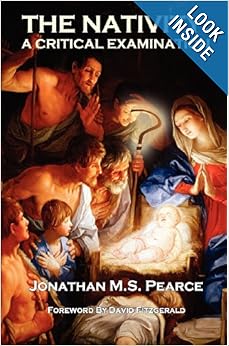
n addition, also in the spirit of the season, Jonathan Pearce (mastermind behind ATP) has a book entitled The Nativity: A Critical Examination

that does a very thorough job collating the various scholarship on aspects of the Nativity story that we are familiar with (and yet, which doesn't actually appear in any of the gospels). From the back of the book:
The nativity of Jesus is an event that carries much cultural recognition. However, is it a narrative which commands much support in the academic world? Is it a story which holds much historical truth? Or were the two biblical accounts of the birth of Jesus an opportunity for the authors to impart a theological truth or otherwise? These are the sort of questions that are often asked of the nativity accounts and questions which are answered in this concise and yet well-researched and informative book. Some twenty arguments are looked at and presented in a clear and detailed manner, building a cumulative case for the objection to the historical nature of the Gospel accounts. The author also questions what purpose these stories do serve if indeed they do carry little or no historical truth. With reference to a wide array of contemporary and iconic works on the subject, Pearce has created a compendium of critical arguments against the historicity of a story which still remains a vital piece of our collective cultural and religious tapestry.
Next, let me remind you of the anthology of deconversion accounts edited by myself and Tristan Vick called Beyond an Absence of Faith. These came from a great variety of sources from around the world and with a good gender balance.
Pearce and Vick have brought together a diverse group of voices with one thing in common - they have moved beyond being "former believers" into being active participants in humanity. Each of the stories shared is unique, but former believers will find something they can identify with in every one. From the pain of separation from friends and family, to the joy of being liberated from a sexist mindset, to the harsh reality of having to find a new career in the middle of your life because you have embraced reason, these personal stories help to reinforce for the non-believer that you are not alone in your journey. Instead, you are walking a path many have gone down before, and you can take solace in knowing that these authors have been there as well.


Next up is 13 Reasons to Doubt

, the first book from the Skeptic Ink Network with whom I used to blog. It contains 13 chapters by various SIN bloggers (including myself) and offers a really satisfying variety. As I said when it was released:
...this is a very solid book. The topics are very wide ranging (as befits the diversity of the authors) and covers topics outside of the "typical" skeptical ones (e.g., what some people deride as "Bigfoot skepticism"). Instead, you have philosophers, archaeologists, psychologists, anthropologists and more discussing topics from why skepticism is important to cognitive biases to science denialism and more. My personal favorite chapters are those by Russell Blackford and Jacques Rousseau, who both happen to be philosophers and skeptics.
Next up is a recent ebook only release, an amalgamation of arguments from this blog with some original extras, all at a very reasonable price. It is called The Problem with "God". The arguments look to debunk the notion of God as defined in classical theism: omni this and omni that. Let my first reviewer give their opinion:
Think of this as Jonathan Pearce's greatest hits all compiled together. He is one of the most interesting and convincing philosophers of modern times. Some of my favorite posts are here, which I have at my fingertips when I need its resource.
It was somewhat difficult to read this on my phone, I don't usually read kindle books, I prefer old school books, but I managed to just finish it.
These blogs are fascinating, deep and well written and persuasively convincing of why theism fails on several accounts. The choice of topics are amazing, and no one can deliver this as good as Pearce can.
If you are a Christian, you won't find this book rude or obnoxious, it is fair, well balanced and I encourage you to give it a chance. Challenge yourself, for no one will challenge you better than Johnny can.
Excellent selection and content, and Johnny hits another home run.
The most recent of my published works is Filling the Void: A Selection of Humanist and Atheist Poetry. There is often thought, by theists, to be a void in humanist and atheist lives; a god-shaped hole. For many atheists, though, that void is amply filled with meaning and purpose, nobly and morally built up out of philosophy and living a fulfilled life. This volume helps to document that through a wide variety of verse, form, and content with poems from an interesting array of writers, detailing a range of emotions and thoughts.
There has been a void, a lacking, of collections of atheistic artistry, and this selection hopes to remedy such a situation, and in doing so seeks to show how humanists can and do weave lives that are rich tapestries of morality, purpose, awe and wonder.
“Jonathan Pearce has done us a great service in producing this anthology. Filling the Void is eclectic, witty, arresting, philosophical, and fun. It charts a course through the emotional landscape of atheism and fills a niche in humanist literature that’s been vacant for far too long.” David Warden, Chair of Dorset Humanists"Read this extraordinary book; feel the wonder and take delight in the fact that we are that singular facet of the universe able to contemplate itself through science and art and to create poetry in the intersection of the two." David Fitzgerald, author of Nailed and The Complete Heretic’s Guide to Western Religion series
The next books are ones which I have edited and been involved in publishing, through Onus Books.
This first one comes from Professor Caleb Lack - Psychology Gone Astray: A Selection of Racist & Sexist Literature from Early Psychological Research

. As he said in an interview about the book's release:

The book addresses an often-ignored issue in psychology: how the results of numerous poorly conducted psychological studies were used to support and justify both scientific and institutionalized sexism and racism....If we do not learn how to spot such dubious research and results, we will likely fall prey to such problems again and again.
He also talked about what they uncovered in their examination of early psychological research in a podcast with the Blue Ball Skeptics, or you can read a sample in this previous post. If you'd like to get any of his others books (with Lack as solo author or contributing a chapter), just head over to his Amazon author page. I have been involved in publishing four of his books.
Next up is The Star of Bethlehem: A Skeptical View
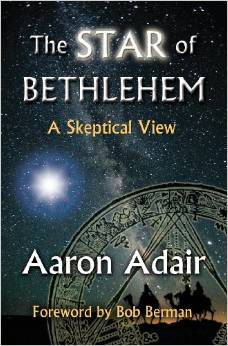

by Aaron Adair (who has previously written for the A Tippling Philosopher blog here). As Caleb Lack said when he reviewed it:
Adair writes in clear, concise prose, which is very helpful when you are reading about a scientific field that you have little to no training in. My formal experience with astronomy is minimal, although I do own a telescope and host the occasional star-gazing party.... Nonetheless, despite my ignorance of the field, I never felt lost or confused when reading SOB.
Adair is a clean writer, without the superfluousness that sometimes plagues writers early in their career. In terms of content, Adair does a great job at covering all bases. The book is broadly divided into three sections (The Story, The Hypotheses, and Fatal Problems), with the majority of the book examining the specific natural hypotheses that have been proposed over the centuries to explain the story of the Star as told in the Gospel of Matthew (and only that particular gospel, something many people don’t know).
James A. Lindsay, a mathematician who has also contributed in the past to ATP, wrote a book titled Dot, Dot, Dot: Infinity Plus God Equals Folly

:
Infinity and God have been close bedfellows over the recent millennia of human thought. But this is James A. Lindsay's point. These two ideas are thought, mere concepts. Lindsay shows in a concise and readable manner that infinity is an abstraction, and shows that, in all likelihood, so is God, particularly if he has infinite properties.
This book is about math. It is about God. It is about stressing the importance of not confusing these two ideas with reality. Never the twain shall meet.
"A short and engaging read on the meeting of two huge ideas, infinity and God, that leaves us seeing both as abstract ideas that may have nothing to do with reality. Honest and accessible, Dot, Dot, Dot is a great little book to stretch your thinking." - Peter Boghossian, author of A Manual for Creating Atheists
I have recently ventured out with Rebecca Bradley, author and blogger at SIN at Lateral Truth, into the world of fiction publishing. Our first project was her own new book which is called Cadon, Hunter. It's a great read, and does deal with religion, destiny and early society with subtle brilliance. Here is my short review of the book:
I whistled through this book, testament to the writing and the pacing in Bradley's first in hopefully further instalments. Bradley is a good writer. You can easily say that and have the sentence passed over as a mere generalised statement. But I mean it. She writes very well, characterising with aplomb, nailing the point of views of each person in the story and giving you something on every page.
Bradley has a history in, well, history (of the ancient kind) with her background in archaeology. This shines through with her hypothesising of rituals, events, clothing, language, culture etc. This adds to what is a rich tapestry of storytelling, interspersed with some dry humour, which keeps you turning the pages breezily because those ideas and nuggets are interwoven seamlessly. There are some fascinating elements of early religious thought and criticism as the societies of the established culture comes into clash with the People, the wondering hunter gatherers which certainly piqued my interest.
In sum, it is a darkly funny clash of ancient cultures and I hope Bradley continues to write further stories in what could be a great series.
Bradley's critically acclaimed Gil Trilogy books are available on Loom. The first, Lady in Gil, has many great reviews, eg:
I've been on a pop-fantasy kick for a month or so now, due to stress and the need for some escapism :-). Limited myself to books of 300 pages or less; no trilogies, must have characters speaking in modern-not-archaic English, that sort of thing. Mind candy. So imagine my shock when this particular bit of mind candy turned out to be unique, thought provoking, and ultimately borderline Greek-tragic.
Bradley takes your biggest, hugest, most dusty-hoary fantasy cliche of all time -- unlikely hero must find talisman to free the land from evil -- and turns it upside down simply by injecting a bit of reality into it. A cold dash of fist-to-the-gut realism. The evil empire is not magic, for one (nice!). And what happens when the upheaval is over? No happy-go-lucky jaunt off into the perfect sunset for these revolutionaries.
Of course now I hop onto Amazon to gush in surprise, only to find that this is indeed a trilogy and now I'm hooked. Darn.
We don't stop there with Bradley as she has two more on Loom. The Lateral Truth: An Apostate's Bible Stories is an original take on the good ole Bible stories that we know and, er, love... Was Moses really such a great liberator? How did a thug as thick as Samson get to be a hero? Wasn't the miracle at Bethesda about as merciful as pulling wings off flies? The fifteen stories in "The Lateral Truth" follow selected biblical themes through to their illogical conclusions, building on questions the author was never brave enough to ask in Sunday school.
The Lateral Truth is a sendup of some favorite bible stories and Christian history, done in Rebecca Bradley's inimitable style of entertaining wit, insight and unique perspective. She presents the tales from the different perspectives of lesser known participants in the stories, or by very human thoughts and feelings of familiar characters.She begins the book with Omphalos, a tale of hope and exploration, transitioning into "a few years later" and how politics and the administrative process has sucked the life out of creation. The tale of Jacob is then related in sit-com style, which adds a new perspective not only to the story but makes one wonder how many other stories could benefit from this treatment. Rebecca then adds darkness to the tale of Moses. It is told from just outside the inner circle and is voiced with frustration, fear, disgust, anger, and hoplessness. She shows, succinctly, how the right con-man/madman at the right place and time can start a cult. This is the strongest chapter in the book, in my opinion. Immediately lightening the mood, Rebecca relates Samson as a fan in a bar may talk of their favorite sports team or hero. Following up on the sports motif, she relates Judges 19-21 from a soldiers point of view. The next chapter still hints at sport but with a poker or chess nature. The real twist is that the foes are trying to throw the game for their own egotistic purposes and they don't care who gets decimated in the process. This provides good transition to the next chapter which pointedly indicates deities disdain for humankind. Rebecca then proceeds to the new testament and with ascerbic and entertaining wit, she constructs 3 tales that state how "The Emperor Has No Clothes" in no uncertain terms. She then returns to the sports motif for a finely constructed "Pre-Game Show", building expectation to the kickoff. Rebecca's Coda gently depresses and horrifies us before she once more imbues the final chapter with a sense of hope and wonder in the intellect of humanity. This book is a wonderful journey, presenting side roads for further personal exploration and a warm feeling for the future of mankind in its quest for self definition.
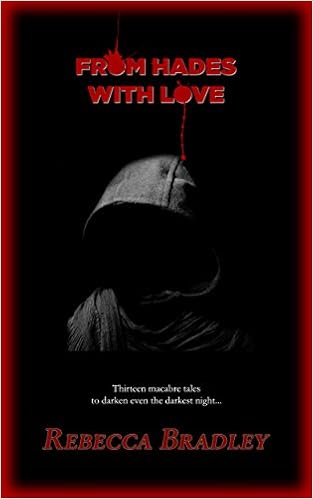
Finally, a collection of some of her short horror stories completes the published list. From Hades With Love is an anthology of thirteen eerie stories. The dark side of life, and the light side of hell—from a haunted refrigerator to an ancient demon, these thirteen tales range from the monstrous and spectral, to the grotesque shadows cast by the most ordinary of things.
And finally, finally, I have two books due for imminent release. Firstly, there is my venture into fiction myself, with the book Survival of the Fittest: Metamorphosis, which integrates philosophy and zombies. Nice. I'll keep you posted on this one.
Lastly, I am hopefully going to release my book documenting the problems with the Kalam Cosmological Argument in Countering the Kalam. This should be released in the next month or so. Again, details will follow.
Busy, busy.